


Photo: Illustrative
Bitcoin Core Patches Bug That Let One Repeated Transaction ID Freeze a Node
Bitcoin Core disclosed a bug on Friday as CVE-2026-117348 and released versions 30.5 and 31.3 with fixes. Developers found that a node could be temporarily stopped from handling network messages by feeding it a single transaction ID repeated 50,000 times. The advisory credits an automated AI scan run through Project Loupe at Spiral, the open source unit of Jack Dorsey's Block. Core developers rated the flaw medium severity and easily discoverable.
.jpeg)
Bitcoin Core disclosed a bug on Friday as CVE-2026-117348 and released versions 30.5 and 31.3 with fixes. Developers found that a node could be temporarily stopped from handling network messages by feeding it a single transaction ID repeated 50,000 times. The advisory credits an automated AI scan run through Project Loupe at Spiral, the open source unit of Jack Dorsey’s Block. Core developers rated the flaw medium severity and easily discoverable.
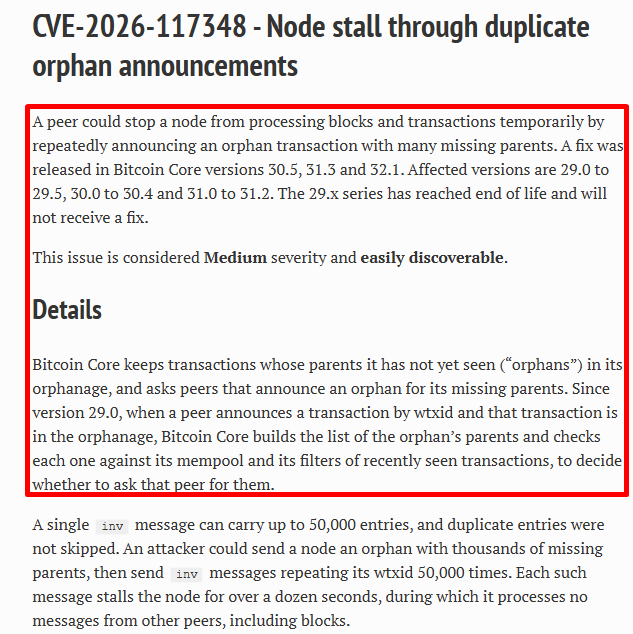
How the Orphan Transaction Attack Worked
Nodes keep orphan transactions, which are payments that spend coins from an earlier transaction the node has not yet seen, and then go looking for the missing parents. Since version 29.0, the software builds a list of those parents and checks its records before requesting anything. Nodes announce transactions in batches of up to 50,000 entries, and the code did not skip repeats. An attacker could send an orphan with thousands of missing parents, then repeat its ID 50,000 times in one announcement, forcing the same costly checks again and again. The advisory says each message stalls the node for over a dozen seconds, and more messages could extend the disruption. The fix makes the node handle each announced transaction only once per batch.
Risks for Exchanges and Miners
While stalled, a node ignores messages from other nodes, including new blocks. An exchange relying on an affected node could be slow to credit deposits, and a miner could waste computing power on an outdated view of the blockchain.
Bitcoin’s New Security Disclosure Policy
Under the security policy adopted on Oct. 22, easily discoverable flaws get fixes across maintained versions as soon as possible, with a public advisory released alongside. The approach reflects developers’ concern that AI tools make some vulnerabilities cheap for attackers to find again, which weakens the value of keeping fixes quiet.
Live market reaction
Disclaimer
This content is for informational purposes only and does not constitute financial, investment, or legal advice. Cryptocurrency trading involves risk and may result in financial loss.
Start trading
with BloFin today
Up to $500 sign-up bonus and zero-fee trading on your first 30 days.
Buy crypto nowYou will be redirected to BloFin
About the author
Emerging voice in crypto journalism with a background in fintech and digital economics. Covers DeFi, NFTs, and the evolving regulatory landscape.

Air Force’s Cloud One Platform Reportedly Hit by Hackers, Putting Sensitive Military Data at Risk
 Guylian ·

Australia Imposes Counterterrorism Financing Sanctions on Two Men Over Iran Directed Arson Attacks
 Laurisa ·

Ethereum Developers Set Dec. 15 for Glamsterdam Hoodi Testnet Launch After Gas Pricing Delay
Guylian ·