

Photo: Illustrative
Blockchain Association Urges SEC to Scrap Old NMS Rules, Points to Tokenization Gains
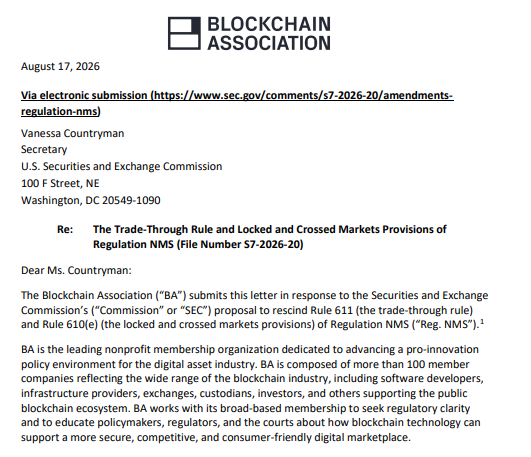
The Blockchain Association has formally endorsed the Securities and Exchange Commission's proposal to eliminate two long-standing Regulation National Market System rules, arguing the change would support the growth of tokenized markets. The industry group submitted its letter to the SEC on Monday, urging the agency to move ahead with rescinding Rules 611 and 610(e), both put in place in 2005 under Regulation NMS.
.jpeg)
The Blockchain Association has formally endorsed the Securities and Exchange Commission’s proposal to eliminate two long-standing Regulation National Market System rules, arguing the change would support the growth of tokenized markets. The industry group submitted its letter to the SEC on Monday, urging the agency to move ahead with rescinding Rules 611 and 610(e), both put in place in 2005 under Regulation NMS.
Rule 611 requires trading platforms to honor better-priced quotes available on other markets, a protection against trade-throughs for NMS stocks. Rule 610(e), meanwhile, limits the display of locked and crossed quotations.
Rules Called Outdated and Costly
The association said the two rules have failed to accomplish what they were originally designed to do and have instead placed unnecessary financial burdens on market participants over the past twenty years.
The SEC first proposed dropping the rules back in June, arguing the move could simplify overall market structure and lower costs across the board. The public comment period on the proposal closed this past Monday.
Group Says Tokenization Strengthens the Case for Change
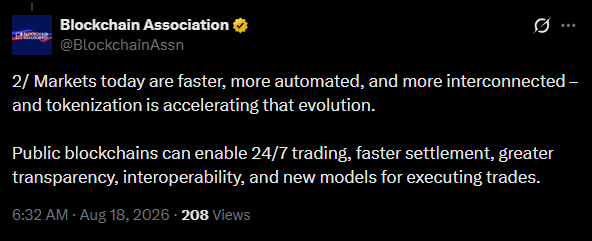
In a series of posts on social media, the Blockchain Association argued that markets have changed dramatically since 2005, becoming faster, more automated, and increasingly interconnected, a shift it says tokenization is now accelerating. The group described the growing practice of representing traditional assets on public blockchains as a major turning point for market structure.
According to the association, the existing rules currently hold back the development of infrastructure built around tokenized markets. It added that the same reasoning behind rescinding the rules also supports weighing the benefits of tokenized securities when evaluating how transactions should be executed.
Call for Broader Regulatory Recognition
The group also pushed the SEC to update its best-execution guidance and formally recognize that trading tokenized securities on public blockchains can meet existing regulatory standards. It specifically asked the agency to treat onchain execution methods as a valid way of achieving fair and efficient trade execution.
Live market reaction
Disclaimer
This content is for informational purposes only and does not constitute financial, investment, or legal advice. Cryptocurrency trading involves risk and may result in financial loss.
Start trading
with BloFin today
Up to $500 sign-up bonus and zero-fee trading on your first 30 days.
Buy crypto nowⓘ You will be redirected to BloFin
About the author
Emerging voice in crypto journalism with a background in fintech and digital economics. Covers DeFi, NFTs, and the evolving regulatory landscape.
 Tristan R. ·
.jpeg&w=32&q=75) Laurisa ·
Laurisa ·