


Photo: Illustrative
Blockstream Unveils Offline First Institutional Crypto Custody Built With Thales
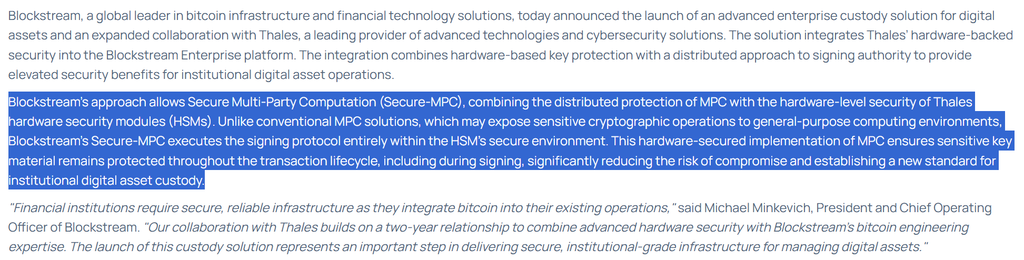
Blockstream, the Bitcoin infrastructure firm led by Adam Back, has rolled out a custody product for institutions created together with French technology group Thales. It pairs Thales hardware security modules with Blockstream's Secure-MPC technology, so organizations can approve transactions while the most sensitive cryptographic steps stay inside dedicated security hardware. Many standard MPC setups carry out part of the signing process outside protected devices. Blockstream says its design runs the whole signing protocol within the secure environment of the Thales modules.

Blockstream, the Bitcoin infrastructure firm led by Adam Back, has rolled out a custody product for institutions created together with French technology group Thales. It pairs Thales hardware security modules with Blockstream’s Secure-MPC technology, so organizations can approve transactions while the most sensitive cryptographic steps stay inside dedicated security hardware. Many standard MPC setups carry out part of the signing process outside protected devices. Blockstream says its design runs the whole signing protocol within the secure environment of the Thales modules.
Why Adam Back Favors Cold Storage
Back, a cryptographer whose Hashcash work helped shape Bitcoin’s proof of work, argues that most MPC protocols are too intricate and need too much back and forth between devices to function in a fully offline setting. He says that complexity makes them hard to secure. In his view, any equipment linked to the internet carries risk, even behind firewalls, because attackers can slip into a network or get hold of logins they should never have.
Lessons From the Binance Hack
Back cited the $6.3 billion Binance breach as an example of what can go wrong with connected custody systems. Binance’s own investigation found that attackers compromised employee devices and gained credentials that opened the door to the exchange’s wallet signing infrastructure.
AI Raises the Stakes for Crypto Security
Back also warned that AI tools can help attackers spot small implementation mistakes inside complex MPC code, flaws that may not be obvious to human reviewers. He hopes the wider custody industry will adopt similar offline models and move assets into cold storage. His summary of the approach: complexity works against security, and returning to basics is the answer.
Live market reaction
Disclaimer
This content is for informational purposes only and does not constitute financial, investment, or legal advice. Cryptocurrency trading involves risk and may result in financial loss.
Start trading
with BloFin today
Up to $500 sign-up bonus and zero-fee trading on your first 30 days.
Buy crypto nowYou will be redirected to BloFin
About the author
8+ years covering crypto markets, macro, and geopolitics. Previously at Decrypt and CoinDesk. Focused on the intersection of digital assets and traditional finance.

Air Force’s Cloud One Platform Reportedly Hit by Hackers, Putting Sensitive Military Data at Risk
 Guylian ·

Australia Imposes Counterterrorism Financing Sanctions on Two Men Over Iran Directed Arson Attacks
 Laurisa ·

Ethereum Developers Set Dec. 15 for Glamsterdam Hoodi Testnet Launch After Gas Pricing Delay
Guylian ·