


Photo: Illustrative
Ethereum Developers Draft Plan to Shield Staking From Future Quantum Threats
A group of Ethereum researchers has proposed reworking the network's validator deposit system to guard against potential future attacks from quantum computers. The plan focuses on the deposit contract, the mechanism users go through to lock up ETH and become validators, the participants who verify transactions and keep the blockchain running.
.jpeg)
A group of Ethereum researchers has proposed reworking the network’s validator deposit system to guard against potential future attacks from quantum computers. The plan focuses on the deposit contract, the mechanism users go through to lock up ETH and become validators, the participants who verify transactions and keep the blockchain running.
Why the Current System Needs Updating
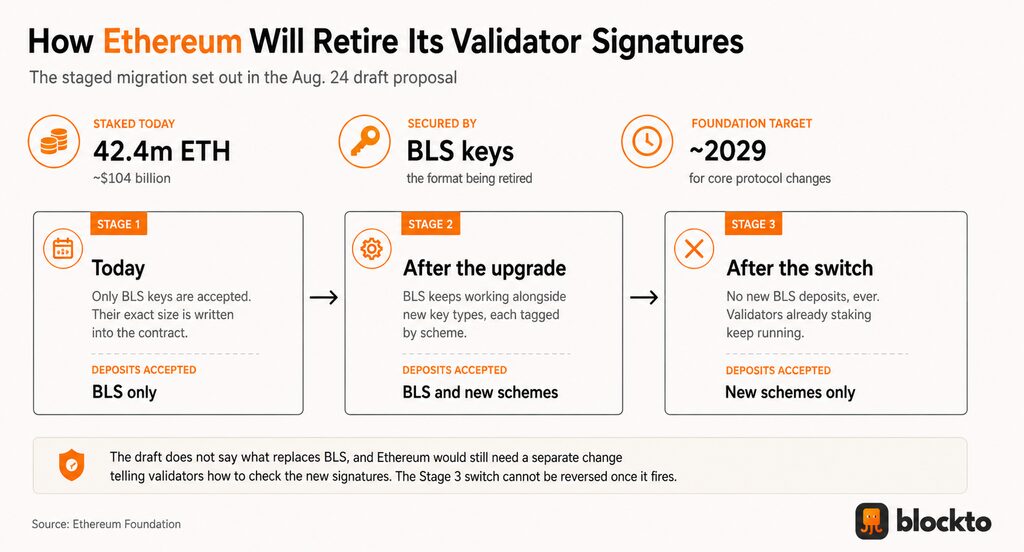
Validators currently rely on BLS signatures, a method that lets hundreds of thousands of individual signatures combine into one, keeping the network’s operations affordable. The problem is that this system depends on mathematical structures that a sufficiently powerful quantum computer could theoretically break, allowing an attacker to fake a validator’s signature. Roughly 42.4 million ETH, worth about $104 billion, is currently staked using this format.
A Gradual Transition, Not a Sudden Switch
The draft proposal would let the network accept new, quantum resistant signature types alongside existing BLS keys rather than replacing them overnight. Existing validators wouldn’t lose their stake, but new validators would eventually be blocked from joining using the older format once regulators phase it out. The Ethereum Foundation is targeting around 2029 for these broader protocol changes.
Live market reaction
Disclaimer
This content is for informational purposes only and does not constitute financial, investment, or legal advice. Cryptocurrency trading involves risk and may result in financial loss.
Start trading
with BloFin today
Up to $500 sign-up bonus and zero-fee trading on your first 30 days.
Buy crypto nowⓘ You will be redirected to BloFin
About the author
Emerging voice in crypto journalism with a background in fintech and digital economics. Covers DeFi, NFTs, and the evolving regulatory landscape.

 Guylian ·

.jpeg&w=32&q=75) Laurisa ·
Laurisa ·