

Photo: Illustrative
Ethereum Researchers Propose Cutting Transaction Finality From 16 Minutes to Four
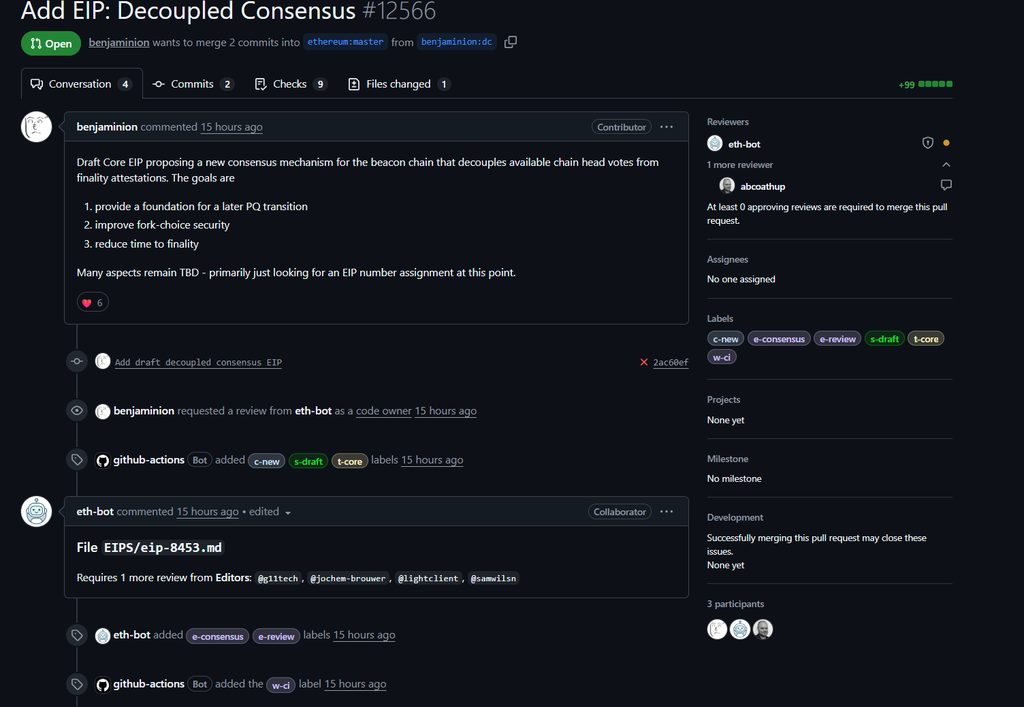
Ethereum researchers want to shorten the wait for a transaction to become final from about 16 minutes to roughly four, which could make moving money between blockchains cheaper. Ben Edgington, who coordinates the network's fast finality research, filed the draft on Wednesday with Francesco D'Amato, Roberto Saltini, Yann Vonlanthen and Mikhail Kalinin. The design is unfinished and has no activation date. Edgington wrote that many aspects remain to be decided, and the immediate goal is getting a proposal number, which places the idea in Ethereum's formal upgrade pipeline. Voting timings, penalties and parts of the security analysis are still open.
.jpeg)
Ethereum researchers want to shorten the wait for a transaction to become final from about 16 minutes to roughly four, which could make moving money between blockchains cheaper. Ben Edgington, who coordinates the network’s fast finality research, filed the draft on Wednesday with Francesco D’Amato, Roberto Saltini, Yann Vonlanthen and Mikhail Kalinin. The design is unfinished and has no activation date. Edgington wrote that many aspects remain to be decided, and the immediate goal is getting a proposal number, which places the idea in Ethereum’s formal upgrade pipeline. Voting timings, penalties and parts of the security analysis are still open.
Why Faster Finality Lowers Cross-Chain Transfer Costs
Finality is the point where validators commit to never rewriting a block. Transfer services often pay customers instantly from funds they hold on the other network, then wait for Ethereum to settle before being repaid. That idle money is a real cost. A service fronting $1 million an hour would have about $267,000 waiting with a 16-minute delay, but only about $67,000 at four minutes. Circle already charges 0.01%, or $1 per $10,000, for its fast USDC route from Ethereum, while its standard route has no Circle fee.
How Splitting the Validator Vote Works
Today each validator casts one vote that both helps choose the next block and locks older blocks in, and finality needs two full voting rounds. The proposal gives each job its own vote so locking can run on a faster clock. The researchers say this would also ease a future move to quantum resistant signatures. Even at four minutes, Ethereum would still trail Solana, whose Alpenglow upgrade targets finality in about 150 milliseconds.
Live market reaction
Disclaimer
This content is for informational purposes only and does not constitute financial, investment, or legal advice. Cryptocurrency trading involves risk and may result in financial loss.
Start trading
with BloFin today
Up to $500 sign-up bonus and zero-fee trading on your first 30 days.
Buy crypto nowⓘ You will be redirected to BloFin
About the author
Emerging voice in crypto journalism with a background in fintech and digital economics. Covers DeFi, NFTs, and the evolving regulatory landscape.

 Guylian ·


 Laurisa ·