


Photo: Illustrative
Global Crypto Tax Reporting Rules Miss Most Taxable Activity, Chainalysis Finds
Blockchain analytics firm Chainalysis estimates that at least $457 billion in potentially taxable onchain crypto activity took place worldwide in 2025, yet international tax reporting rules capture only a small slice of it. The United States accounted for roughly $112.6 billion of that total, with North America leading all regions at $134.6 billion, followed closely by the European Union at $125.1 billion.
.jpeg)
Blockchain analytics firm Chainalysis estimates that at least $457 billion in potentially taxable onchain crypto activity took place worldwide in 2025, yet international tax reporting rules capture only a small slice of it. The United States accounted for roughly $112.6 billion of that total, with North America leading all regions at $134.6 billion, followed closely by the European Union at $125.1 billion.
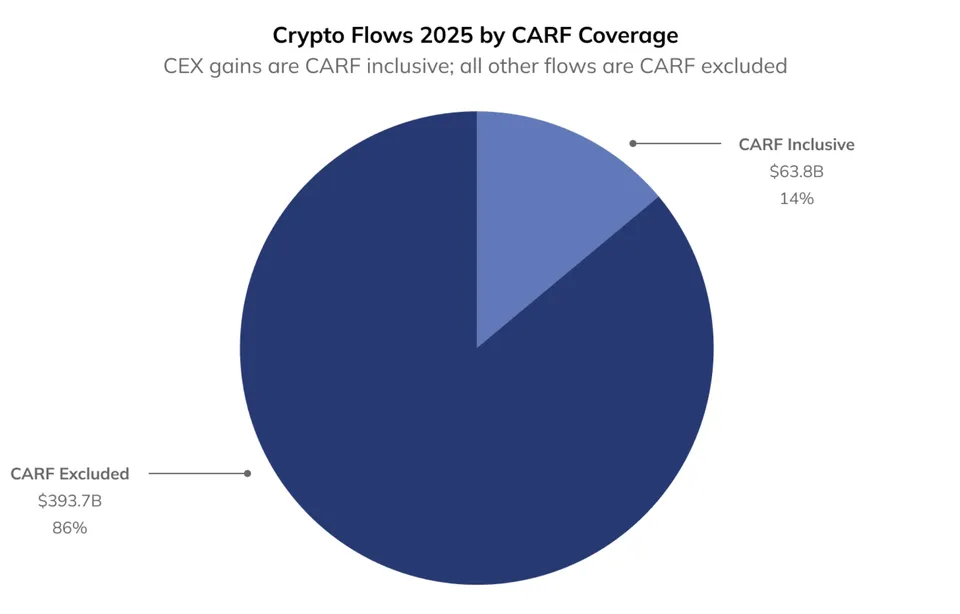
Reporting Framework Covers Just 14% of Activity
According to the report, transactions covered by the OECD’s Crypto-Asset Reporting Framework, known as CARF, represent only 14% of the onchain taxable activity identified. The remaining 86% includes activity happening on decentralized exchanges, peer-to-peer transfers, staking and mining income, and onchain payments that fall outside the framework’s reach. The estimates account for realized gains and income across six major blockchains but exclude activity conducted within centralized exchanges.
Why the Gap Exists
CARF, developed by the OECD in 2022, requires crypto service providers to collect customer and tax residency information and report transaction data to domestic tax authorities. Data collection under the framework began this January across 48 jurisdictions, including the UK and European Union. However, the framework was built around centralized intermediaries, meaning much of decentralized finance falls outside its scope since many DeFi platforms lack a central operator to hold accountable. Regulators are reportedly watching developments in anti-money laundering rules to determine when DeFi platforms might eventually be treated as regulated service providers.
Live market reaction
Disclaimer
This content is for informational purposes only and does not constitute financial, investment, or legal advice. Cryptocurrency trading involves risk and may result in financial loss.
Start trading
with BloFin today
Up to $500 sign-up bonus and zero-fee trading on your first 30 days.
Buy crypto nowⓘ You will be redirected to BloFin
About the author
Emerging voice in crypto journalism with a background in fintech and digital economics. Covers DeFi, NFTs, and the evolving regulatory landscape.

 Guylian ·

.jpeg&w=32&q=75) Laurisa ·
Laurisa ·