


Photo: Illustrative
Hyperliquid and Paradigm Push for Changes to Stablecoin AML Rules Under GENIUS Act
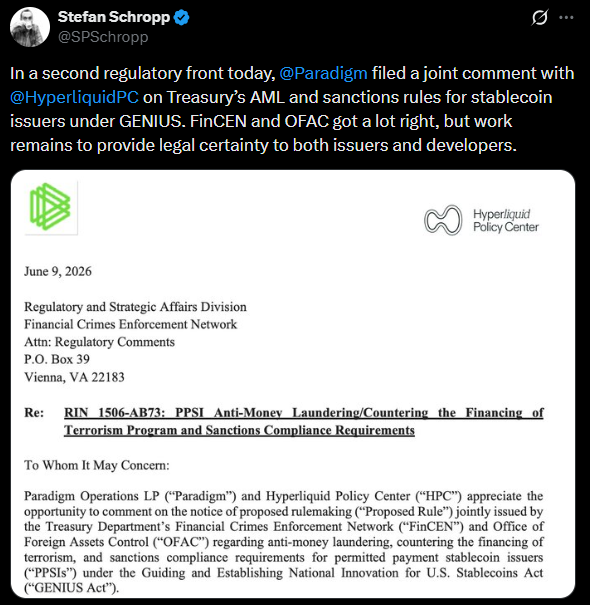
The Hyperliquid Policy Center and venture capital firm Paradigm have called on the US Treasury Department to revise proposed anti money laundering (AML) and sanctions compliance rules for stablecoin issuers under the GENIUS Act. The groups argue that parts of the proposal could create significant challenges for decentralized finance platforms and permissionless blockchain networks.
.jpeg)
The Hyperliquid Policy Center and venture capital firm Paradigm have called on the US Treasury Department to revise proposed anti money laundering (AML) and sanctions compliance rules for stablecoin issuers under the GENIUS Act. The groups argue that parts of the proposal could create significant challenges for decentralized finance platforms and permissionless blockchain networks.
In a joint letter, the organizations supported the principle that compliance responsibilities should primarily remain with entities operating in the primary market, where issuers have direct relationships with customers and access to identity information. They argued that applying similar obligations to secondary market activity would be difficult because issuers typically only see wallet addresses and transaction data rather than the individuals behind them.
Concerns Over Secondary Market Compliance
The proposed rule would require stablecoin issuers to maintain the ability to block, freeze or reject transactions that violate US sanctions laws or other legal requirements across both primary and secondary markets.
Hyperliquid and Paradigm warned that the approach could extend compliance obligations beyond what issuers can realistically monitor or control. They also argued that treating smart contract interactions as potential sanctions liabilities could create legal uncertainty for decentralized applications and blockchain infrastructure.
Potential Impact on Stablecoins and DeFi
According to the groups, the proposal may encourage issuers to limit stablecoin activity to permissioned environments where users are fully identified. They warned this could reduce the role of regulated US dollar stablecoins within decentralized finance and create opportunities for offshore or unregulated alternatives to gain market share.
GENIUS Act Implementation Moves Forward
The GENIUS Act, signed into law last year, established a federal framework for regulating stablecoins in the United States. Federal agencies are now developing implementation rules before the law takes full effect by January 2027.
At the same time, lawmakers continue debating additional digital asset legislation, including proposals that could further define compliance obligations for stablecoin issuers and blockchain developers.
Live market reaction
Disclaimer
This content is for informational purposes only and does not constitute financial, investment, or legal advice. Cryptocurrency trading involves risk and may result in financial loss.
Start trading
with BloFin today
Up to $500 sign-up bonus and zero-fee trading on your first 30 days.
Buy crypto nowⓘ You will be redirected to BloFin
About the author
Emerging voice in crypto journalism with a background in fintech and digital economics. Covers DeFi, NFTs, and the evolving regulatory landscape.

.jpeg&w=32&q=75) Laurisa ·
Laurisa · 
 Tristan R. ·