


Photo: Illustrative
Iran War Pushes Global Corporate Costs Past $25 Billion as Oil Shock Hits Supply Chains
The ongoing US–Israel–Iran conflict has already cost global companies at least $25 billion, and the figure is still rising, according to industry-wide estimates based on corporate disclosures. Firms across the United States, Europe, and Asia are facing higher energy costs, disrupted supply chains, and trade delays linked to instability around the Strait of Hormuz.

The ongoing US–Israel–Iran conflict has already cost global companies at least $25 billion, and the figure is still rising, according to industry-wide estimates based on corporate disclosures. Firms across the United States, Europe, and Asia are facing higher energy costs, disrupted supply chains, and trade delays linked to instability around the Strait of Hormuz.
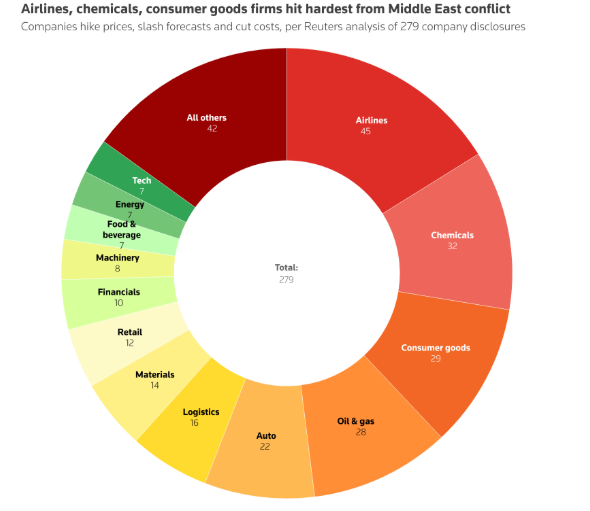
More than 279 companies have reported direct impacts from the conflict. Many have responded by raising prices, cutting production, suspending dividends, or reducing staff. Some firms have also sought government support or added fuel surcharges to manage rising expenses.
Airlines are among the hardest hit, accounting for nearly $15 billion in extra fuel costs as oil prices surge above $100 per barrel. Automakers and consumer goods companies have also reported multi-billion-dollar impacts, including Toyota, which warned of a $4.3 billion hit, and Procter & Gamble, which estimated a $1 billion profit impact.
Oil Prices Drive Inflation and Margin Pressure
The Strait of Hormuz blockade has pushed global oil prices more than 50% higher since before the war, increasing shipping and raw material costs across industries such as chemicals, manufacturing, and logistics. Companies in Europe and Asia are especially exposed due to their reliance on Middle Eastern energy imports.
Executives say rising input costs are already forcing price increases, but analysts warn that profit margins are likely to come under greater pressure in upcoming quarters as companies struggle to pass on higher costs to consumers.
Economists note that the conflict’s impact is similar in scale to past global shocks, with energy costs acting as the main transmission channel. As oil prices remain elevated, businesses are bracing for slower growth, weaker demand, and continued cost pressures across global markets.
Live market reaction
Disclaimer
This content is for informational purposes only and does not constitute financial, investment, or legal advice. Cryptocurrency trading involves risk and may result in financial loss.
Start trading
with BloFin today
Up to $500 sign-up bonus and zero-fee trading on your first 30 days.
Buy crypto nowⓘ You will be redirected to BloFin
About the author
Covers Bitcoin, on-chain data and market structure. Breaks down what the charts and wallet flows are actually saying, without the hype.

 Guylian ·

.jpeg&w=32&q=75) Laurisa ·
Laurisa ·