


Photo: Illustrative
Semiconductor Sell-Off Reveals How Leverage Multiplies Investor Losses
The ongoing chip stock downturn has hit investors hard, but leveraged funds tied to semiconductors have suffered far steeper losses, highlighting the risks of amplified exposure during volatile markets.

The ongoing chip stock downturn has hit investors hard, but leveraged funds tied to semiconductors have suffered far steeper losses, highlighting the risks of amplified exposure during volatile markets.
Leveraged Funds Fall Much Harder Than the Index
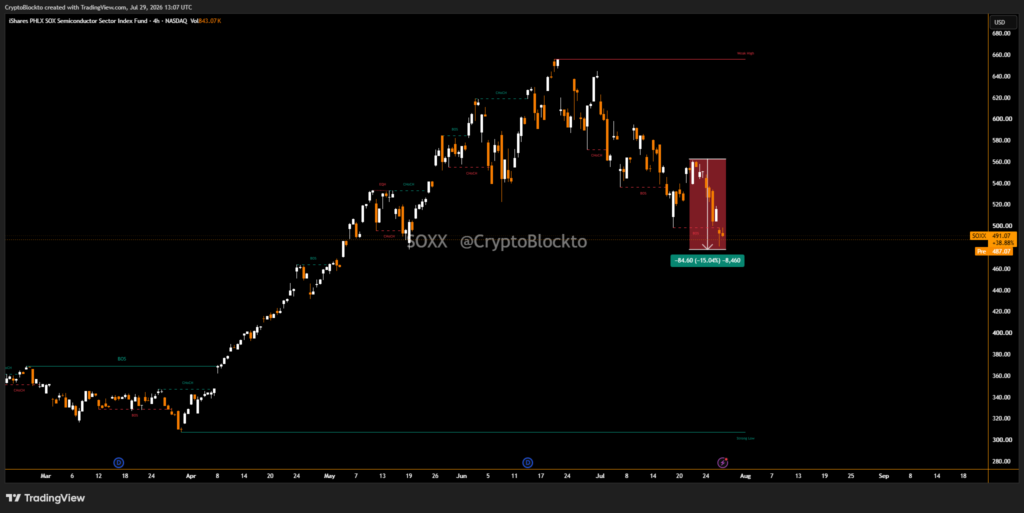
The iShares Semiconductor ETF has dropped roughly 25% from its late June peak, while a leveraged version designed to triple daily semiconductor returns has plunged nearly two-thirds over the same period. The sell-off intensified further after SK Hynix released earnings, briefly sending South Korea’s benchmark index down as much as 13% before recovering some losses, triggering a record number of trading halts.
Why Daily Resets Change the Math
Leveraged funds don’t simply move three times the underlying index over weeks or months. Instead, they reset exposure daily, meaning gains and losses compound from a new starting point each session. This structure performs well during steady rallies but becomes far more damaging during choppy or declining markets, making recovery mathematically harder. While the standard index needs about a 33% gain to erase its losses, the leveraged fund would need a rally of roughly 170% just to break even.
A Growing Corner of the Market
Leverage has increasingly extended into volatile trades across Wall Street, including new products tied to recent public offerings. The largest leveraged ETFs still represent hundreds of billions in total market exposure, even after recent declines, remaining close to historic highs.
Live market reaction
Disclaimer
This content is for informational purposes only and does not constitute financial, investment, or legal advice. Cryptocurrency trading involves risk and may result in financial loss.
Start trading
with BloFin today
Up to $500 sign-up bonus and zero-fee trading on your first 30 days.
Buy crypto nowⓘ You will be redirected to BloFin
About the author
8+ years covering crypto markets, macro, and geopolitics. Previously at Decrypt and CoinDesk. Focused on the intersection of digital assets and traditional finance.

.jpeg&w=32&q=75) Laurisa ·
Laurisa · 
 Tristan R. ·