

Photo: Illustrative
Stablecoin Freezes After the Binance Hack Spark a Double Standard Debate
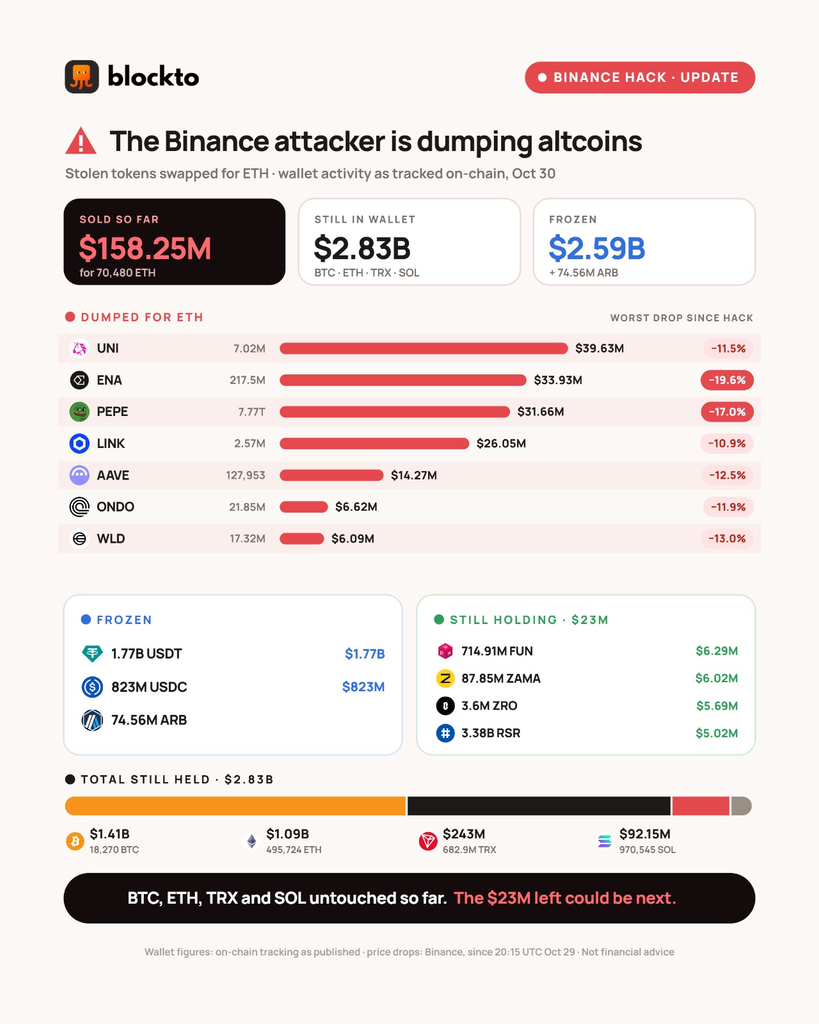
When alleged North Korean hackers took $6.3 billion from Binance, some of crypto's biggest companies stepped in within hours and stopped nearly half of it from disappearing. Tether froze more than $1.56 billion in USDT, Circle blocked about $823 million in USDC, and Ripple and World Liberty Financial froze assets too. Binance says roughly $3 billion is frozen and that it has set aside more than $6.34 billion of its own reserves to cover customer losses. Experts mostly backed the freezes, but many asked why every hack victim does not get the same help.

When alleged North Korean hackers took $6.3 billion from Binance, some of crypto’s biggest companies stepped in within hours and stopped nearly half of it from disappearing. Tether froze more than $1.56 billion in USDT, Circle blocked about $823 million in USDC, and Ripple and World Liberty Financial froze assets too. Binance says roughly $3 billion is frozen and that it has set aside more than $6.34 billion of its own reserves to cover customer losses. Experts mostly backed the freezes, but many asked why every hack victim does not get the same help.
Is There a Double Standard in Crypto Freezes?
Anton Golub of Forte said he fully supports freezing stolen funds, and believes it was done to protect the whole industry, yet he sees a double standard. He noted that smaller victims usually hear about court orders and legal limits. In April, Circle CEO Jeremy Allaire said his firm freezes USDC only when law enforcement or a court directs it, and Tether took a similar stance on Tornado Cash in 2022. Golub also pointed to the roughly $290 million Drift hack in April, when Circle was criticized for not freezing stolen USDC. Tether CEO Paolo Ardoino said protecting the industry and partners is the priority, while Allaire said Circle acted with law enforcement.
Risks Issuers Face When Freezing Tokens
Frank Hepworth of New Market Trading warned that issuers open themselves to liability if they freeze the wrong funds, on top of a heavy operational burden. He said the size of the theft made this a business decision, but it could raise pressure on issuers to act the same way in smaller cases.
Freezing Is Not the Same as Recovering
Irina Heaver of NEOSLegal said a freeze only stops hackers from moving funds and does not return them to Binance. Issuers can invalidate frozen tokens and issue replacements to rightful owners, which may not need a court judgment but does require proof of ownership. Max Atallah of Nordic Law added that a freeze does not decide who owns the assets.
Bitcoin and Arbitrum Show the Limits
Bitcoin has no central issuer, so it cannot be frozen at the network level. The attacker split about $1.4 billion in stolen bitcoin across 19 wallets, though exchanges can block coins that reach them. Golub also raised questions about Arbitrum’s emergency controls, since moving assets that way happens without the owner’s signature.
Live market reaction
Disclaimer
This content is for informational purposes only and does not constitute financial, investment, or legal advice. Cryptocurrency trading involves risk and may result in financial loss.
Start trading
with BloFin today
Up to $500 sign-up bonus and zero-fee trading on your first 30 days.
Buy crypto nowYou will be redirected to BloFin
About the author
Covers Bitcoin, on-chain data and market structure. Breaks down what the charts and wallet flows are actually saying, without the hype.

 Guylian ·
 Tristan R. ·