

Photo: Illustrative
Stellar’s Tokenized Real World Asset Market Surges Past $4 Billion in 2026
The value of tokenized real world assets on the Stellar network has grown by roughly 360% this year, climbing from under $900 million at the end of last year to nearly $4 billion, according to data tracked by Stellar through a Dune Analytics dashboard.

The value of tokenized real world assets on the Stellar network has grown by roughly 360% this year, climbing from under $900 million at the end of last year to nearly $4 billion, according to data tracked by Stellar through a Dune Analytics dashboard.
As of late August, Stellar’s RWA market stood close to $4 billion, made up of tokenized US Treasurys, private and public credit, foreign government debt and other asset categories. A small group of issuers dominates this activity, with Spiko, Realiz, Tradable, Franklin Templeton and Ondo together representing the bulk of the network’s tokenized value.
Government Debt and Stablecoins Gain Traction
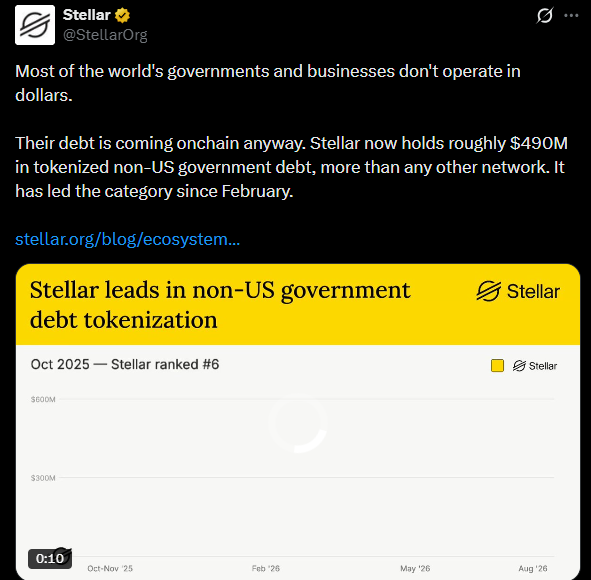
Stellar has also built up a meaningful position in tokenized non US government debt, holding close to $490 million in this category, including Mexican and Brazilian government bonds. Despite this expansion, Stellar’s native token, XLM, remains down for the year, trading near $0.18.
Institutional Partnerships Fuel Expansion
Major financial players have been central to this growth. The Depository Trust & Clearing Corporation plans to connect its tokenization services to Stellar starting in 2027, potentially enabling tokenized Treasurys, ETFs and major US stocks on the network.
Live market reaction
Disclaimer
This content is for informational purposes only and does not constitute financial, investment, or legal advice. Cryptocurrency trading involves risk and may result in financial loss.
Start trading
with BloFin today
Up to $500 sign-up bonus and zero-fee trading on your first 30 days.
Buy crypto nowⓘ You will be redirected to BloFin
About the author
8+ years covering crypto markets, macro, and geopolitics. Previously at Decrypt and CoinDesk. Focused on the intersection of digital assets and traditional finance.

 Guylian ·

.jpeg&w=32&q=75) Laurisa ·
Laurisa ·