

Photo: Illustrative
Tether Hits Back at S&P After USDT Keeps Lowest Stability Score
S&P Global Ratings kept Tether's USDT at 5, the weakest level on its stablecoin stability scale, in a report published November 18. The score is unchanged from a year ago, and Tether responded by pointing to The Big Short, the film about the 2008 financial crisis.

S&P Global Ratings kept Tether’s USDT at 5, the weakest level on its stablecoin stability scale, in a report published November 18. The score is unchanged from a year ago, and Tether responded by pointing to The Big Short, the film about the 2008 financial crisis.
S&P Stablecoin Stability Assessment and USDT Reserve Risks
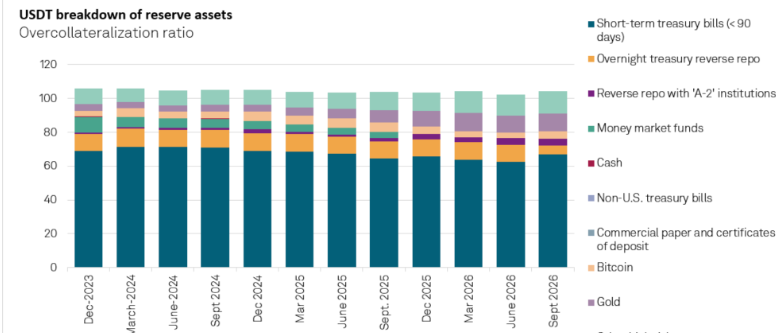
Higher-risk holdings such as gold, Bitcoin, public equities, secured loans and corporate bonds made up 28% of USDT in circulation on September 30, up from 24% a year earlier. S&P warned that a sharp fall in those assets could leave the token undercollateralized. Tether said the problem lies in S&P’s framework, not in its reserves. The agency added that it found further weaknesses but made no downward adjustment, since 5 is the lowest score possible.
Tether Reserve Report and Excess Assets
Tether’s September 30 reserve report, attested by BDO, showed about $191.5 billion in assets against $183.5 billion in liabilities, leaving roughly $7.95 billion in excess.
El Salvador Regulation and Reserve Segregation Concerns
S&P also questioned oversight in El Salvador, where Tether moved in January 2025. The local regulator, CNAD, requires 70% of reserves to be liquid within 30 days, a framework S&P called broad enough to include riskier assets like gold, BTC and loans. It further noted there is no requirement to segregate reserve assets, unlike in the US and Europe, and no public information on how they are shielded from wider corporate risks.
Live market reaction
Disclaimer
This content is for informational purposes only and does not constitute financial, investment, or legal advice. Cryptocurrency trading involves risk and may result in financial loss.
Start trading
with BloFin today
Up to $500 sign-up bonus and zero-fee trading on your first 30 days.
Buy crypto nowYou will be redirected to BloFin
About the author
8+ years covering crypto markets, macro, and geopolitics. Previously at Decrypt and CoinDesk. Focused on the intersection of digital assets and traditional finance.

Air Force’s Cloud One Platform Reportedly Hit by Hackers, Putting Sensitive Military Data at Risk
 Guylian ·

Australia Imposes Counterterrorism Financing Sanctions on Two Men Over Iran Directed Arson Attacks
 Laurisa ·

Ethereum Developers Set Dec. 15 for Glamsterdam Hoodi Testnet Launch After Gas Pricing Delay
Guylian ·