


Photo: Illustrative
AI Helped Ethereum Find A Validator-Crashing Bug, But Humans Had To Confirm It Was Real
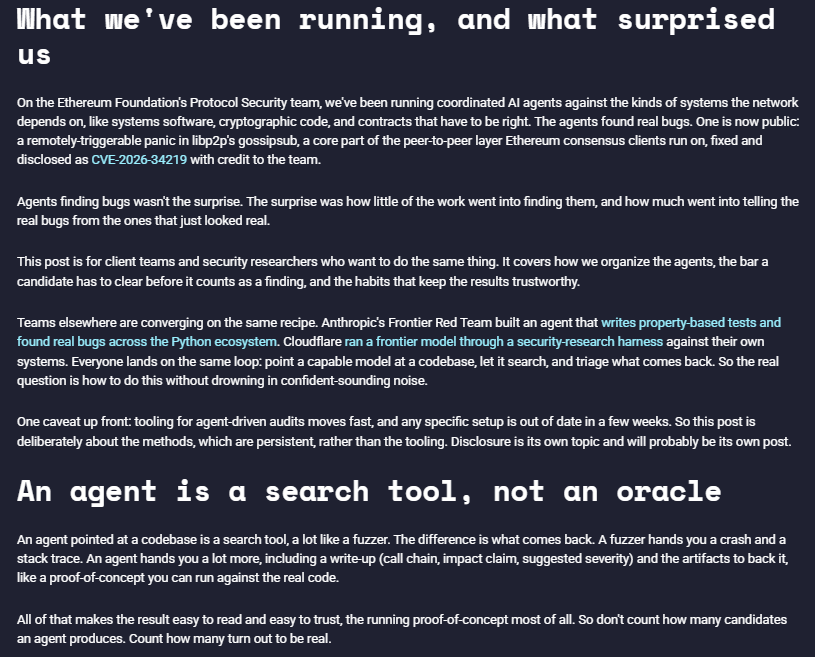
Engineers at the Ethereum Foundation recently turned AI agents loose on the software that keeps validator nodes running, part of an ongoing push to harden the network. The search paid off. The team found a real flaw in gossipsub, the messaging layer that lets nodes talk to each other. A remote attacker could exploit it to force a node into an impossible calculation, causing it to crash and knocking a validator offline until someone manually restarts it. The issue has now been patched and logged as CVE-2026-34219.

Engineers at the Ethereum Foundation recently turned AI agents loose on the software that keeps validator nodes running, part of an ongoing push to harden the network. The search paid off. The team found a real flaw in gossipsub, the messaging layer that lets nodes talk to each other. A remote attacker could exploit it to force a node into an impossible calculation, causing it to crash and knocking a validator offline until someone manually restarts it. The issue has now been patched and logged as CVE-2026-34219.
Separating Real Bugs From Convincing Fakes
The harder part wasn’t finding problems, it was proving which ones actually mattered. Unlike a traditional fuzzing tool that simply reports where code broke, an AI agent builds a full story around a flaw, complete with reasoning, severity scores, and working exploit code. That polish made fake findings just as convincing as genuine ones. Three patterns kept fooling reviewers: crashes that only appear in test builds, attacks that require data no outside actor could realistically deliver, and formal proofs that technically pass without proving anything meaningful.
Why Sequence-Based Exploits Are Harder To Catch
Agents also struggled with multi step attacks, where each individual action looks harmless and the danger only appears once the steps are chained together. That’s the exact pattern behind several recent crypto exploits, including one involving a price feed workaround and another where routine governance actions, buying tokens, voting, then executing, were combined to drain funds. The Foundation’s approach going forward: let AI suggest where to look, but test everything manually before trusting the result.
Live market reaction
Disclaimer
This content is for informational purposes only and does not constitute financial, investment, or legal advice. Cryptocurrency trading involves risk and may result in financial loss.
Start trading
with BloFin today
Up to $500 sign-up bonus and zero-fee trading on your first 30 days.
Buy crypto nowⓘ You will be redirected to BloFin
About the author
8+ years covering crypto markets, macro, and geopolitics. Previously at Decrypt and CoinDesk. Focused on the intersection of digital assets and traditional finance.

.jpeg&w=32&q=75) Laurisa ·
Laurisa · 

 Tristan R. ·