


Photo: Illustrative
Bitcoin’s Annual Gains Are Concentrated in Just a Handful of Trading Days, Study Shows
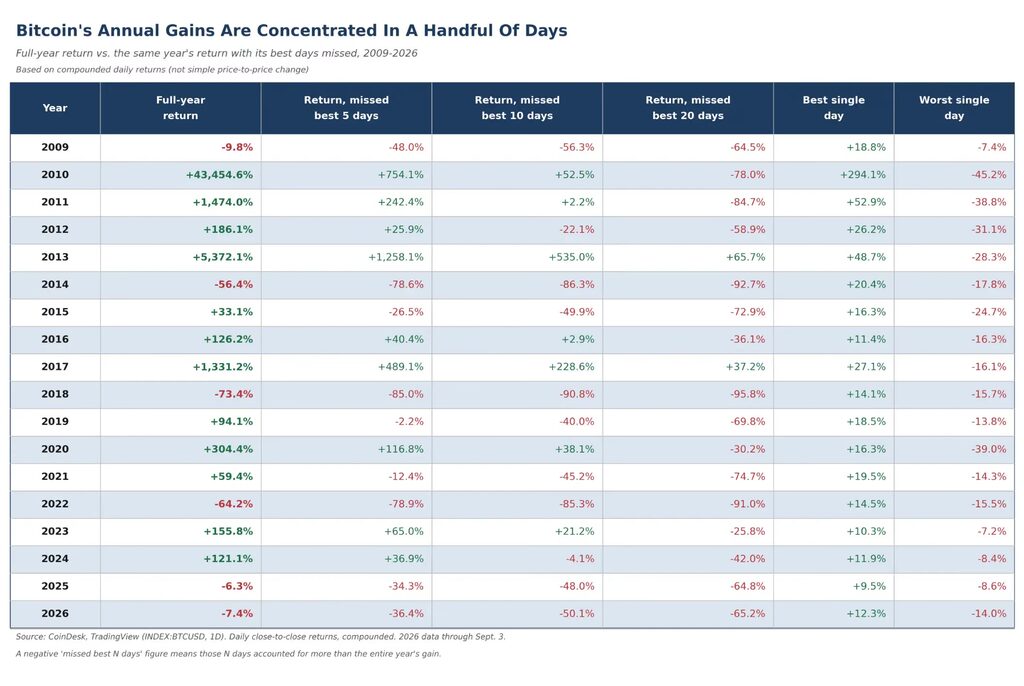
A detailed look at Bitcoin's price history from 2010 through 2026 reveals that the majority of the asset's yearly gains typically occur during a very small number of trading days, rather than being spread evenly throughout the year. According to research shared by industry analysts, removing just the ten best-performing days in any given year is enough to turn a positive year into a losing one in most years examined.
.jpeg)
A detailed look at Bitcoin’s price history from 2010 through 2026 reveals that the majority of the asset’s yearly gains typically occur during a very small number of trading days, rather than being spread evenly throughout the year. According to research shared by industry analysts, removing just the ten best-performing days in any given year is enough to turn a positive year into a losing one in most years examined.
For example, this year Bitcoin recorded a modest single digit percentage decline overall, but excluding its five strongest trading days would have resulted in a much steeper loss. One industry researcher described Bitcoin as fundamentally a relatively quiet asset that spends most of its time consolidating, with major moves concentrated into brief, explosive bursts.
Why Timing the Market Is Extremely Difficult
This pattern makes precise market timing especially challenging, since missing a rally by even a short window can mean missing nearly the entire year’s gains. As a result, analysts suggest that holding Bitcoin over the long term tends to outperform attempts to actively trade around short-term price swings. Historical data also shows that the likelihood of ending up with a loss decreases significantly the longer an investor holds the asset, dropping to very low levels after a multi-year holding period.
Bitcoin’s Volatility Has Declined Over Time
Despite this pattern persisting throughout Bitcoin’s history, the size of its most extreme single day moves has shrunk considerably compared to its earliest years, a shift attributed to growing market maturity, increased institutional participation, and the rise of regulated investment products.
Liquidity Challenges for Large Investors
Market experts also note that Bitcoin’s tendency toward sudden, sharp price moves creates unique liquidity challenges for large institutional traders, since the ability to execute sizable trades smoothly can become significantly harder during these brief but intense market windows. Specialized trading desks and post-trade analysis tools are increasingly being used to help larger investors navigate these episodic market conditions more effectively.
Live market reaction
Disclaimer
This content is for informational purposes only and does not constitute financial, investment, or legal advice. Cryptocurrency trading involves risk and may result in financial loss.
Start trading
with BloFin today
Up to $500 sign-up bonus and zero-fee trading on your first 30 days.
Buy crypto nowⓘ You will be redirected to BloFin
About the author
Emerging voice in crypto journalism with a background in fintech and digital economics. Covers DeFi, NFTs, and the evolving regulatory landscape.

 Guylian ·

.jpeg&w=32&q=75) Laurisa ·
Laurisa ·