

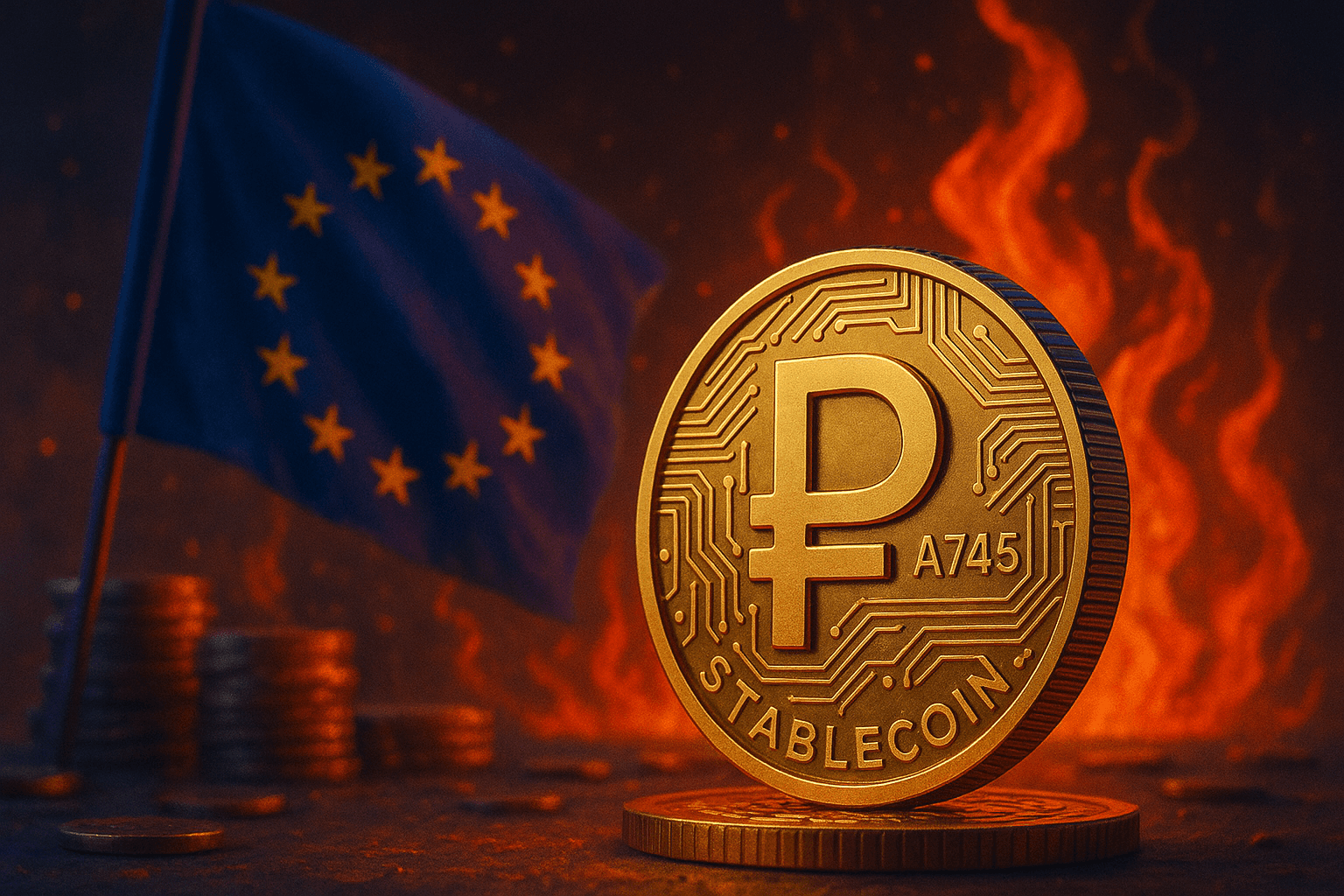
Photo: Illustrative
EU Considers Sanctions on Ruble-Backed Stablecoin A7A5 Amid Rising Crypto Tensions
The European Union (EU) is weighing sanctions against A7A5, a Russian ruble-backed stablecoin that has rapidly grown to become the world’s largest non–US-dollar-pegged stablecoin, according to a Bloomberg report.
.jpeg)
The European Union (EU) is weighing sanctions against A7A5, a Russian ruble-backed stablecoin that has rapidly grown to become the world’s largest non–US-dollar-pegged stablecoin, according to a Bloomberg report.
Interestingly, A7A5’s market capitalization spiked by 250% shortly after the EU’s first wave of crypto-related restrictions.
On Sept. 26, just one week after the sanctions announcement, the stablecoin’s market cap jumped from $140 million to over $491 million, according to CoinMarketCap data.

EU Targets Ruble-Linked Crypto Transactions
If passed, the sanctions would prohibit EU-based entities and individuals from directly or indirectly interacting with the A7A5 token or related parties.
Documents obtained by Bloomberg indicate that the proposal also targets several banks in Russia, Belarus, and Central Asia, accused of facilitating crypto-related transactions for sanctioned entities.
The move underscores the EU’s broader effort to restrict Russia’s financial maneuvering through digital assets — a strategy that has evolved since the bloc’s September 19 sanctions, which blocked all crypto transactions for Russian residents and restricted dealings with foreign banks tied to the Russian financial sector.
Russia’s Expanding Network of Sanction Evasion Tools
Beyond cryptocurrency, Russia has relied on multiple methods to evade Western sanctions, including the use of a “shadow fleet” — hundreds of vessels transporting sanctioned goods and concealing the origins of oil shipments.
According to Integrity Risk International, Russia has also engaged in intermediary trading through non-aligned countries and leveraged illicit gold trades to launder money.
A December 2024 report by RAND Corporation highlighted that gold has been a growing vector in Russia’s sanction circumvention strategies.
The token now holds around $500 million in market value, representing roughly 43% of the total $1.2 billion non–US-dollar stablecoin market.
By comparison, Circle’s euro-pegged EURC ranks second with $255 million in capitalization.
Approval Process and Broader Impact
Under EU procedures, all 27 member states must approve the proposed sanctions before they can take effect. The measures can still be amended or delayed, depending on diplomatic negotiations.
The European Council has emphasized that sanctions are aimed at “those responsible for the policies or actions the EU wants to influence,” serving as a tool to “bring about changes in conduct aligned with EU foreign policy goals.”
Global Alignment on Financial Restrictions
The EU’s stance mirrors that of the United States and the United Kingdom, which both imposed sanctions in August 2025 targeting Russian financial networks allegedly used to bypass Western restrictions.
Those measures included penalties on Capital Bank of Central Asia, its director Kantemir Chalbayev, and Kyrgyzstan-based crypto exchanges Grinex and Meer.
A7A5 was launched in February 2025 on the Ethereum and Tron networks by Moldovan banker Ilan Shor in partnership with Russia’s state-owned Promsvyazbank.
It was marketed as a “token backed by fiat deposits in reliable banks across Kyrgyzstan.”
Despite facing a ban in Singapore, the project appeared at Token2049, where its executive Oleg Ogienko spoke publicly before organizers removed A7A5 from the event lineup after scrutiny.
Disclaimer
This content is for informational purposes only and does not constitute financial, investment, or legal advice. Cryptocurrency trading involves risk and may result in financial loss.
Live market reaction
Disclaimer
This content is for informational purposes only and does not constitute financial, investment, or legal advice. Cryptocurrency trading involves risk and may result in financial loss.
Start trading
with BloFin today
Up to $500 sign-up bonus and zero-fee trading on your first 30 days.
Buy crypto nowⓘ You will be redirected to BloFin
About the author
Emerging voice in crypto journalism with a background in fintech and digital economics. Covers DeFi, NFTs, and the evolving regulatory landscape.

Bitcoin Japan, Still Holding Zero BTC, Plans $60 Million Raise to Finally Make Purchase
 Tristan R. ·
US Regulators Miss Deadline for Finalizing Stablecoin Rules Under GENIUS Act
Tristan R. · 
Tokenization Becomes Top Priority for 84% of Financial Institutions, Survey Finds
Tristan R. ·