

Photo: Illustrative
FATF Calls for Faster Crypto AML Action as Stablecoin-Linked Crime Rises
The Financial Action Task Force has warned that criminals are increasingly turning to stablecoins for illicit financial activity, with most identified onchain criminal cases now tied to dollar-pegged cryptocurrencies.
.jpeg)
The Financial Action Task Force has warned that criminals are increasingly turning to stablecoins for illicit financial activity, with most identified onchain criminal cases now tied to dollar-pegged cryptocurrencies.
Key Findings From the Report
In a report published Thursday, the global anti-money laundering watchdog said criminal networks have gone a step further by developing their own proprietary stablecoins, specifically designed to resist asset freezes and seizures. FATF is now pushing countries to speed up implementation of crypto anti-money laundering standards as illicit actors continue to find and exploit regulatory gaps.
Progress on the Travel Rule, But Gaps Remain
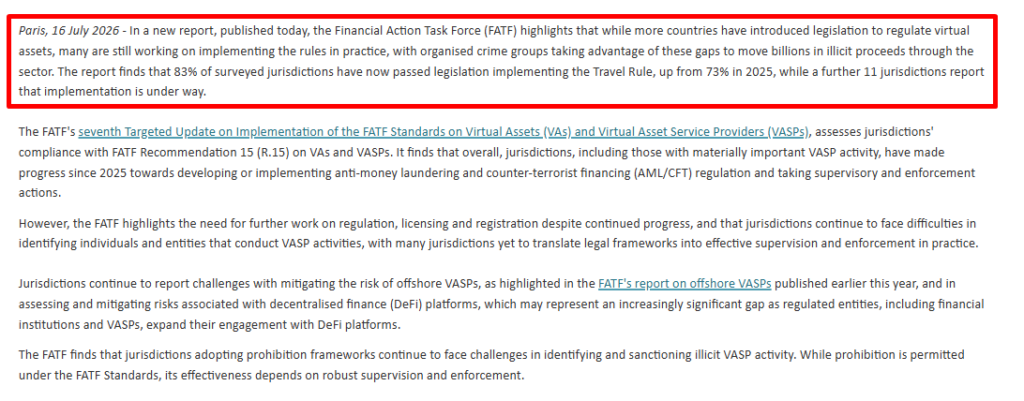
The findings come from FATF’s annual review assessing how well countries have implemented its AML standards for crypto assets. The report found that 83% of surveyed jurisdictions have now written the Travel Rule into law, up from 73% the previous year. However, FATF noted that many countries still haven’t turned these legal frameworks into meaningful supervision or actual enforcement on the ground.
The Travel Rule requires financial institutions and virtual asset service providers to share sender and receiver details for cross-border payments and crypto transactions above a set threshold, typically $1,000 or 1,000 euros, as a tool against money laundering and terrorist financing.
Ongoing Regulatory Blind Spots
FATF also flagged continued difficulty in regulating offshore crypto service providers operating outside typical jurisdictional reach. The report singled out decentralized finance as an area of particular concern, warning that DeFi platforms could become an increasingly significant blind spot for regulators if oversight doesn’t keep pace with the sector’s growth.
Live market reaction
Disclaimer
This content is for informational purposes only and does not constitute financial, investment, or legal advice. Cryptocurrency trading involves risk and may result in financial loss.
Start trading
with BloFin today
Up to $500 sign-up bonus and zero-fee trading on your first 30 days.
Buy crypto nowⓘ You will be redirected to BloFin
About the author
Emerging voice in crypto journalism with a background in fintech and digital economics. Covers DeFi, NFTs, and the evolving regulatory landscape.

 Tristan R. ·