


Photo: Illustrative
FX Layer Explained How Spark and Uniswap Are Solving the Stablecoin Liquidity Problem
Spark and Uniswap have announced the FX Layer a shared stablecoin exchange system built on Uniswap v4, designed to let institutions move between dollar-pegged tokens quickly and with minimal slippage.

Spark and Uniswap have announced the FX Layer a shared stablecoin exchange system built on Uniswap v4, designed to let institutions move between dollar-pegged tokens quickly and with minimal slippage.
The idea behind it is simple. Instead of every stablecoin issuer building their own liquidity pools, market makers and inventory systems from scratch, the FX Layer gives banks, fintechs and payment companies a common infrastructure to plug into. Spark handles how liquidity is allocated and coordinated across different stablecoins. Uniswap provides the programmable AMM architecture underneath.
$150 Million Is Already Moving In
To get things started, Spark is migrating $150 million from its USDS ecosystem to Uniswap v4 as a liquidity foundation for a swap pool supporting USDS, Tether’s USDT and PayPal’s PYUSD.
USDS is the USD-pegged stablecoin issued by Sky formerly MakerDAO and is the direct successor to DAI. It currently sits as the third-largest stablecoin overall and the largest crypto-native option behind Tether and Circle.
Why This Matters Now
The launch comes as stablecoin issuance is accelerating following the passage of the GENIUS Act, with institutions increasingly looking to launch their own branded stablecoins. Some analysts have projected stablecoin volumes could reach $1.5 quadrillion by 2035 if adoption by Visa and Mastercard-scale networks plays out.
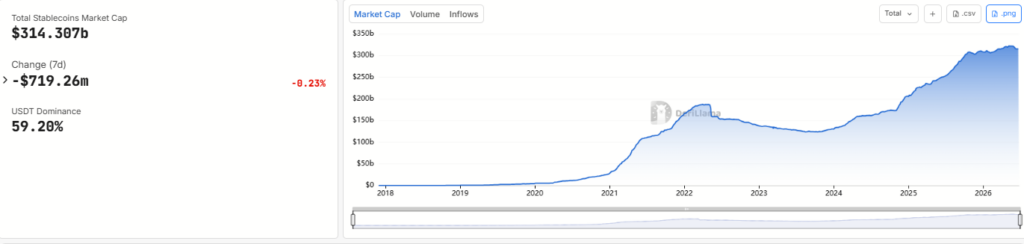
But critics have pointed out a real problem if moving between different dollar pegged stablecoins is expensive or unreliable, real-world adoption will stay limited compared to alternatives like tokenized deposits or CBDCs.
“The next generation of stablecoins won’t be defined by who can issue another digital dollar,” Spark CEO Sam MacPherson said. “It will be defined by the infrastructure that allows hundreds of issuers to operate together at global scale.”
Live market reaction
Disclaimer
This content is for informational purposes only and does not constitute financial, investment, or legal advice. Cryptocurrency trading involves risk and may result in financial loss.
Start trading
with BloFin today
Up to $500 sign-up bonus and zero-fee trading on your first 30 days.
Buy crypto nowⓘ You will be redirected to BloFin
About the author
8+ years covering crypto markets, macro, and geopolitics. Previously at Decrypt and CoinDesk. Focused on the intersection of digital assets and traditional finance.

 Tristan R. ·