


Photo: Illustrative
Iran to Charge Maritime Service Fees in Strait of Hormuz After Waiver Period
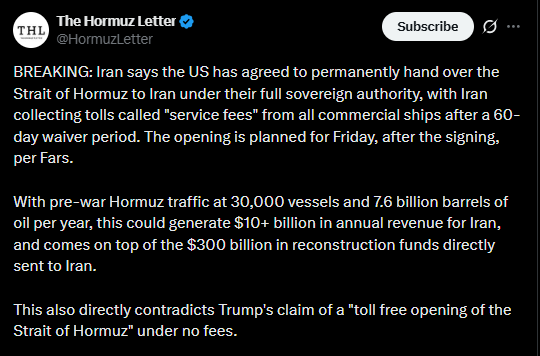
Iran has confirmed that commercial vessels passing through the Strait of Hormuz will be required to pay maritime service fees after a 60-day waiver period. Iranian officials stressed that the charges are not transit tolls but payments for services provided to ships navigating one of the world's most important shipping routes.

Iran has confirmed that commercial vessels passing through the Strait of Hormuz will be required to pay maritime service fees after a 60-day waiver period. Iranian officials stressed that the charges are not transit tolls but payments for services provided to ships navigating one of the world’s most important shipping routes.
Foreign Ministry spokesperson Esmail Baghaei said the fees will cover navigation assistance, environmental protection measures, insurance services and other maritime support operations.
Tehran Maintains Distrust Despite US-Iran Agreement
The announcement comes shortly after Iran and the United States reached a framework agreement aimed at ending months of conflict. While Tehran welcomed the deal as a positive step, Iranian officials emphasized that deep mistrust toward Washington remains.
Baghaei stated that Iran’s concerns stem from a long history of disputes with the United States and said rebuilding trust would take time. He described the agreement as an initial step rather than a final resolution.
Reconstruction Funds and Frozen Assets Remain Key Issues
Iran also expects progress on the release of frozen overseas assets and compensation for war-related damages as part of broader negotiations. Reports suggest a reconstruction package worth around $300 billion could support rebuilding efforts.
With maritime service fees expected to generate additional revenue and major reconstruction funding under discussion, Iran could secure significant new financial resources in the coming years while maintaining control over a critical global trade corridor.
Live market reaction
Disclaimer
This content is for informational purposes only and does not constitute financial, investment, or legal advice. Cryptocurrency trading involves risk and may result in financial loss.
Start trading
with BloFin today
Up to $500 sign-up bonus and zero-fee trading on your first 30 days.
Buy crypto nowⓘ You will be redirected to BloFin
About the author
8+ years covering crypto markets, macro, and geopolitics. Previously at Decrypt and CoinDesk. Focused on the intersection of digital assets and traditional finance.

 Tristan R. ·