

Photo: Illustrative
Russia Sanctions Teen Researcher Over Report on Ruble-Backed Stablecoin A7A5
A 17-year-old British researcher has become the focus of Russian sanctions after publishing findings related to the ruble backed stablecoin A7A5 and its alleged role in helping users bypass international financial restrictions.

A 17-year-old British researcher has become the focus of Russian sanctions after publishing findings related to the ruble backed stablecoin A7A5 and its alleged role in helping users bypass international financial restrictions.
Alexander Browder, who operates the Global Crypto Laundering Database, said Russian authorities targeted him following a report released in March. The report claimed that A7A5 was backed by deposits from Russian financial institution Promsvyazbank and was being used to help move funds despite sanctions imposed by Western countries following Russia’s war in Ukraine.
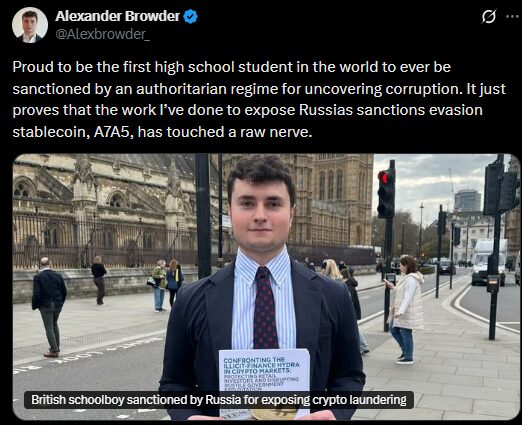
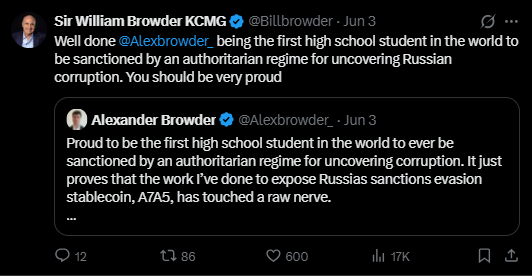
His father, political activist Bill Browder, said his son may be the youngest person ever sanctioned by Russia and described him as the first high school student targeted by an authoritarian government over anti-corruption research.
A7A5 Stablecoin Faces International Scrutiny
A7A5 has attracted growing attention from regulators and policymakers. European Union authorities sanctioned the stablecoin in October 2025, arguing that it was designed to help bypass financial restrictions placed on Russia.
According to recent blockchain analysis, the token has processed more than $110 billion in onchain transactions. Critics argue that its ability to convert digital assets into cash through certain exchanges remains a significant concern for governments seeking to enforce sanctions.
Russia Expands Focus on Cryptocurrency Regulation
The dispute comes as Russian lawmakers consider stricter oversight of the digital asset industry. A bill currently under review would require crypto service providers to register with the country’s central bank and could introduce criminal penalties for operating without authorization.
Debate Over Sanctions and Digital Assets Continues
The case highlights the growing intersection between crypto , international sanctions and geopolitical tensions. As governments increase scrutiny of digital assets, stablecoins linked to sanctioned entities are expected to remain a major focus for regulators and enforcement agencies worldwide.
Live market reaction
Disclaimer
This content is for informational purposes only and does not constitute financial, investment, or legal advice. Cryptocurrency trading involves risk and may result in financial loss.
Start trading
with BloFin today
Up to $500 sign-up bonus and zero-fee trading on your first 30 days.
Buy crypto nowⓘ You will be redirected to BloFin
About the author
8+ years covering crypto markets, macro, and geopolitics. Previously at Decrypt and CoinDesk. Focused on the intersection of digital assets and traditional finance.

.jpeg&w=32&q=75) Laurisa ·
Laurisa · 
 Tristan R. ·