
Photo: Illustrative
U.S. Traders Lead Polymarket’s Political Betting Despite Official Ban
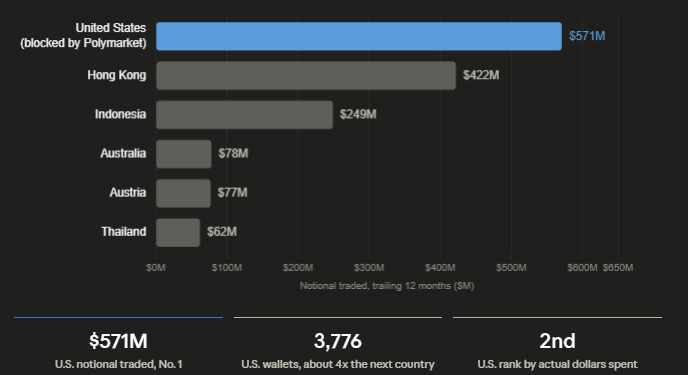
Even though Polymarket cannot legally serve U.S. users, wallets tied to America made up the platform's largest national trading group in political markets, moving $571 million in notional value over the past year. That put the U.S. ahead of Hong Kong, which traded $422 million, according to a new report from on-chain analysis firm Allium.
.jpeg)
Even though Polymarket cannot legally serve U.S. users, wallets tied to America made up the platform’s largest national trading group in political markets, moving $571 million in notional value over the past year. That put the U.S. ahead of Hong Kong, which traded $422 million, according to a new report from on-chain analysis firm Allium.
How Americans Get Around the Block
Polymarket blocks U.S. users by IP address, but Allium says this does little since the platform runs entirely on crypto, using just a wallet and stablecoins with no bank or broker involved. That means there’s no account to freeze and no payment to stop, so a VPN combined with an existing crypto wallet is enough to access the platform. Allium identifies country ties through on-chain wallet behavior rather than IP address, which is why the same VPN that fools Polymarket’s block doesn’t hide these wallets from its data. The firm can only tie about 6% of political-market wallets to a specific country, so it describes the numbers as directional rather than exact.
Americans Favor Foreign Conflicts Over Elections
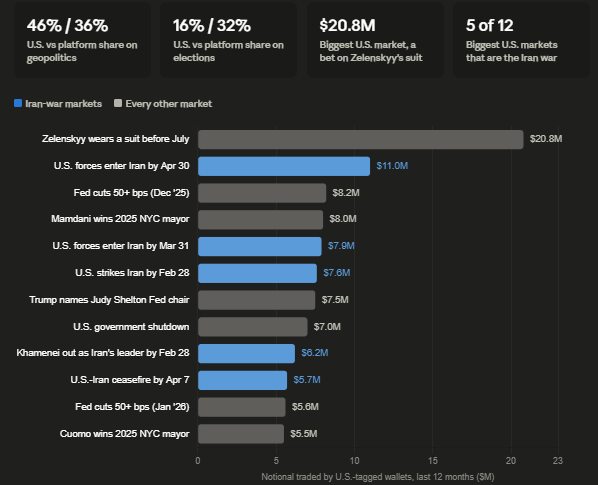
The breakdown of what U.S. wallets bet on stands out. Geopolitics accounted for 46% of American trading volume compared to 36% platform-wide, while elections made up just 16% of U.S. activity against 32% for the platform overall. Five of the U.S. cohort’s twelve largest markets were tied to the Iran war, and its single biggest position, at $20.8 million, was a novelty market on whether Ukrainian President Volodymyr Zelenskyy would wear a suit. These are largely markets that regulated U.S. platforms like Kalshi don’t offer, since compliant venues mostly stick to economic data, rate decisions, and elections.
Bold Bets, But No Real Edge
Despite trading more aggressively, U.S. wallets didn’t outperform other traders. On resolved markets, American wallets picked the winning side 81.9% of the time, close to the 80.3% rate for everyone else, with nearly identical returns. At one point, Americans placed 53% of their volume on a U.S. invasion of Iran while the rest of the market sat at just 26%, showing bolder positioning without better results.
What the Data Suggests
The report indicates that banning U.S. access didn’t stop American participation, it simply pushed the largest political betting market offshore, where it remains visible on-chain but outside U.S. regulatory reach, with demand concentrated in exactly the markets domestic rules restrict
Live market reaction
Disclaimer
This content is for informational purposes only and does not constitute financial, investment, or legal advice. Cryptocurrency trading involves risk and may result in financial loss.
Start trading
with BloFin today
Up to $500 sign-up bonus and zero-fee trading on your first 30 days.
Buy crypto nowⓘ You will be redirected to BloFin
About the author
Emerging voice in crypto journalism with a background in fintech and digital economics. Covers DeFi, NFTs, and the evolving regulatory landscape.
 Tristan R. ·