

Photo: Illustrative
Fed Chair Kevin Warsh Reshapes How Markets Should Read the Jobs Report
Federal Reserve Chairman Kevin Warsh is changing how investors should interpret upcoming economic data, particularly Friday's closely watched jobs report. Rather than offering direct signals about future rate decisions, Warsh has laid out a broader framework covering inflation, labor conditions, demand, corporate activity and financial markets, encouraging investors to draw their own conclusions from the data instead of waiting for explicit Fed guidance.

Federal Reserve Chairman Kevin Warsh is changing how investors should interpret upcoming economic data, particularly Friday’s closely watched jobs report. Rather than offering direct signals about future rate decisions, Warsh has laid out a broader framework covering inflation, labor conditions, demand, corporate activity and financial markets, encouraging investors to draw their own conclusions from the data instead of waiting for explicit Fed guidance.
His current economic outlook leans cautious, pointing to a still-solid job market, inflation pressures that remain elevated, and financial conditions that appear far from restrictive.
Why Weak Jobs Numbers Alone May Not Shift Policy
Warsh has argued that slower labor force growth means the economy now needs fewer new jobs each month to keep unemployment steady. He has also highlighted the four-week average of jobless claims as a particularly reliable real-time indicator of labor market health. As a result, a single weak payroll report may not significantly influence his thinking unless it’s accompanied by rising unemployment and a sustained increase in jobless claims.
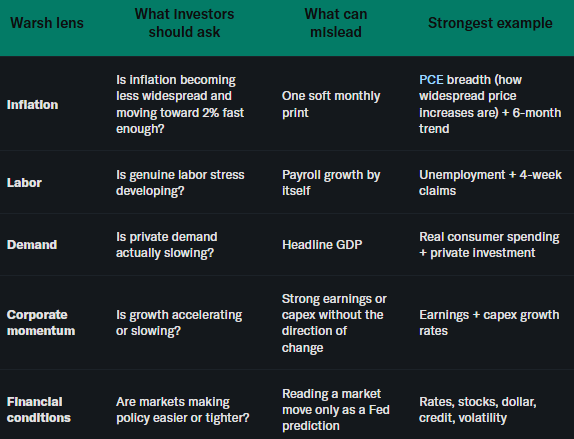
Some economists argue that despite Warsh’s stated intention to avoid giving direct forward guidance, his detailed economic framework effectively functions the same way, giving markets a clearer sense of what would or wouldn’t shift his position.
Key Areas Warsh Is Watching Closely
Warsh has outlined several major areas guiding his economic assessment, including how widespread inflation remains across different price categories, genuine signs of labor market stress beyond simple payroll numbers, real changes in consumer spending and investment, corporate earnings momentum, and how financial conditions like interest rates and market volatility are influencing the broader economy.
According to Warsh, recent inflation data has not shown meaningful underlying improvement, even as headline figures softened slightly over the summer.
Live market reaction
Disclaimer
This content is for informational purposes only and does not constitute financial, investment, or legal advice. Cryptocurrency trading involves risk and may result in financial loss.
Start trading
with BloFin today
Up to $500 sign-up bonus and zero-fee trading on your first 30 days.
Buy crypto nowⓘ You will be redirected to BloFin
About the author
Covers Bitcoin, on-chain data and market structure. Breaks down what the charts and wallet flows are actually saying, without the hype.

 Guylian ·

.jpeg&w=32&q=75) Laurisa ·
Laurisa ·