


Photo: Illustrative
US National Debt Climbs to Record $39.5 Trillion, Raising Questions for Everyday Finances and Crypto
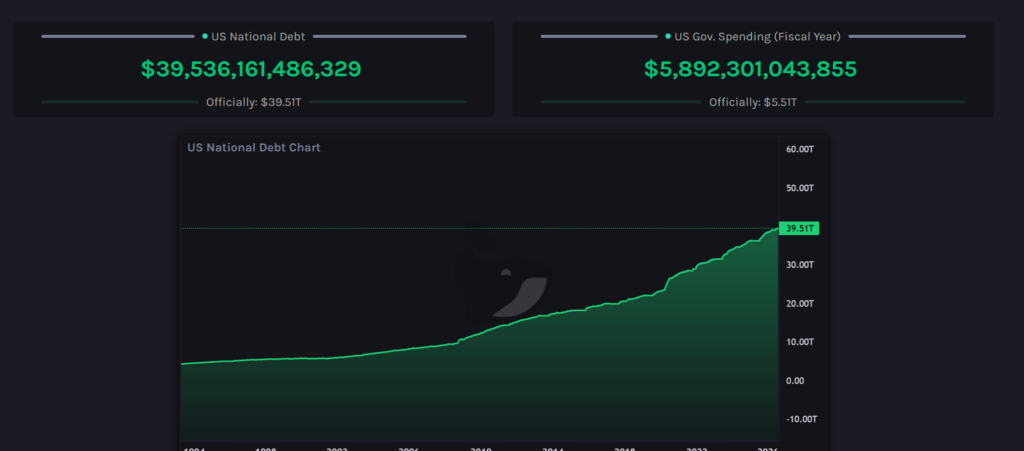
The US national debt has reached a fresh record of roughly $39.5 trillion as of mid-2026, a figure so large it becomes difficult to grasp without breaking it down. Divided across the population, that comes to about $115,000 per person and nearly $292,000 per household. Over just the past year, the debt has grown by approximately $2.8 trillion, or roughly $7.7 billion every single day.
.jpeg)
The US national debt has reached a fresh record of roughly $39.5 trillion as of mid-2026, a figure so large it becomes difficult to grasp without breaking it down. Divided across the population, that comes to about $115,000 per person and nearly $292,000 per household. Over just the past year, the debt has grown by approximately $2.8 trillion, or roughly $7.7 billion every single day.
Interest Payments Are Where It Gets Real
Two figures stand out beyond the headline number. First is the pace: the debt crossed $39 trillion earlier this year and is on track to hit $40 trillion before year’s end, growing faster than the broader economy. Second, and more directly felt by households, is the interest bill. Net interest payments on the debt are projected to reach roughly $1.04 trillion this fiscal year, translating to about $7,700 per household simply to cover interest, a figure now approaching 14% of total federal spending.
How This Reaches Ordinary People
The debt doesn’t arrive as a direct bill, but it filters down through a few channels. Heavy government borrowing tends to push up interest rates broadly, making mortgages, car loans and credit cards more expensive. There’s also persistent pressure toward higher inflation, since inflation effectively reduces the real value of both government debt and household savings. Additionally, as more of the federal budget goes toward interest payments, fewer resources remain for other priorities, creating longer-term drag on wage growth and job creation.
The Connection to Bitcoin and Crypto
For many, rising government debt strengthens the case for holding assets with a fixed supply, since no central authority can create more of them to offset fiscal shortfalls. Bitcoin, with its capped supply of 21 million coins, has increasingly been framed as protection against this kind of currency erosion, shifting for some from a speculative bet to a deliberate long-term hedge. Rather than reacting to headlines, many holders lean toward gradually accumulating over time.
A Necessary Word of Caution
Despite the debasement argument, crypto has historically behaved more like a risk asset in the short term, often falling alongside stocks during periods of market stress rather than acting as a reliable safe haven. Bitcoin’s price in the near term still responds far more to Federal Reserve policy and overall market liquidity than to debt figures alone. Rising debt doesn’t guarantee rising crypto prices on any predictable timeline, and a debt-driven spike in interest rates could just as easily pull money away from riskier assets, including crypto, at least temporarily.
Live market reaction
Disclaimer
This content is for informational purposes only and does not constitute financial, investment, or legal advice. Cryptocurrency trading involves risk and may result in financial loss.
Start trading
with BloFin today
Up to $500 sign-up bonus and zero-fee trading on your first 30 days.
Buy crypto nowⓘ You will be redirected to BloFin
About the author
Emerging voice in crypto journalism with a background in fintech and digital economics. Covers DeFi, NFTs, and the evolving regulatory landscape.

 Tristan R. ·