


Photo: Illustrative
CrowdStrike, US Authorities Take Down Russian Botnet That Stole Crypto for 8 Years
CrowdStrike and federal law enforcement have dismantled Sality, a Russia based botnet active since 2003 that spent the last eight years quietly hijacking cryptocurrency transactions. The malware exploited a common habit among crypto users: copying and pasting long wallet addresses instead of typing them manually.

CrowdStrike and federal law enforcement have dismantled Sality, a Russia based botnet active since 2003 that spent the last eight years quietly hijacking cryptocurrency transactions. The malware exploited a common habit among crypto users: copying and pasting long wallet addresses instead of typing them manually.
How the Attack Worked
The malware’s core component, dubbed EggJagger by CrowdStrike, monitored infected computers’ clipboards. Whenever it detected something resembling a bitcoin or ether address, it silently swapped the copied text with an address controlled by the attacker.
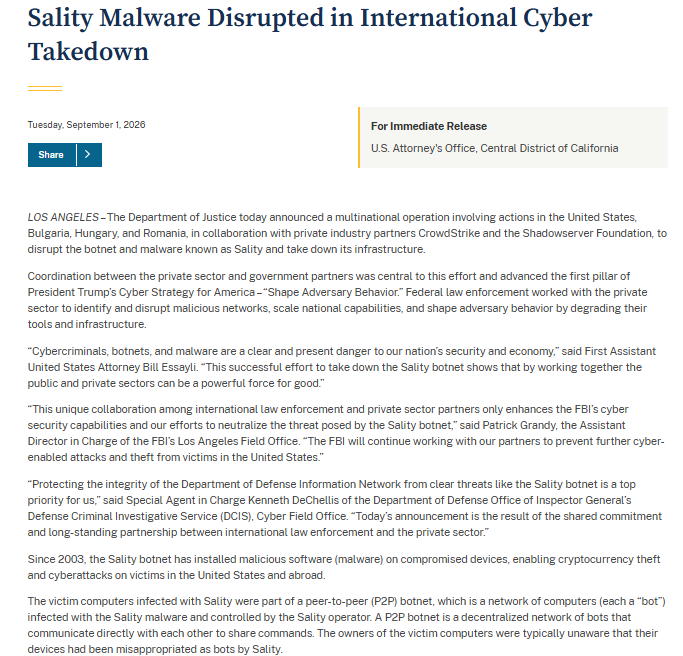
Victims who pasted and sent funds had no way to catch the switch, and the transaction could not be reversed. Security experts recommend checking the first and last characters of any pasted address before confirming a transaction.
Losses Reached Over $1 Million at Peak Prices
CrowdStrike estimates the attackers stole at least 12.1 million rubles, roughly $150,000, over eight years. Much of that crypto sat untouched in wallets, and as prices rose, its value climbed to as much as $1.35 million by early 2025.
No Central Server, But a Fatal Flaw
Sality had no single command server to shut down. Instead, infected machines communicated directly with each other, checking in roughly every 40 minutes and spreading through shared network drives and USB devices. The system accepted any responding computer as part of the network without verifying its identity, a weakness CrowdStrike exploited to insert its own servers and cut off communication.
More Than 15,000 Machines Isolated
The takedown was carried out during a live demonstration at CrowdStrike’s Day Zero summit in Las Vegas, isolating over 15,000 infected machines from the botnet. Authorities confirmed the operation was based in Russia.
Live market reaction
Disclaimer
This content is for informational purposes only and does not constitute financial, investment, or legal advice. Cryptocurrency trading involves risk and may result in financial loss.
Start trading
with BloFin today
Up to $500 sign-up bonus and zero-fee trading on your first 30 days.
Buy crypto nowⓘ You will be redirected to BloFin
About the author
Covers Bitcoin, on-chain data and market structure. Breaks down what the charts and wallet flows are actually saying, without the hype.

 Guylian ·
.jpeg&w=32&q=75) Laurisa ·
Laurisa ·