

Photo: Illustrative
Crypto Industry Pushes Back Against SEC’s Proposed Blanket Rules for Novel ETFs
Major crypto industry players have asked the US Securities and Exchange Commission to avoid grouping all "novel" exchange-traded funds under a single set of restrictions, arguing instead for evaluations based on each product's actual risk profile.

Major crypto industry players have asked the US Securities and Exchange Commission to avoid grouping all “novel” exchange-traded funds under a single set of restrictions, arguing instead for evaluations based on each product’s actual risk profile.
Industry Groups Push for Individual Assessment
Venture capital firm a16z called on the SEC to judge new ETF products based on their underlying characteristics rather than blanket categorization. The firm also recommended coordinating fund-registration and exchange-listing reviews while establishing clearer, more predictable timelines for approval.
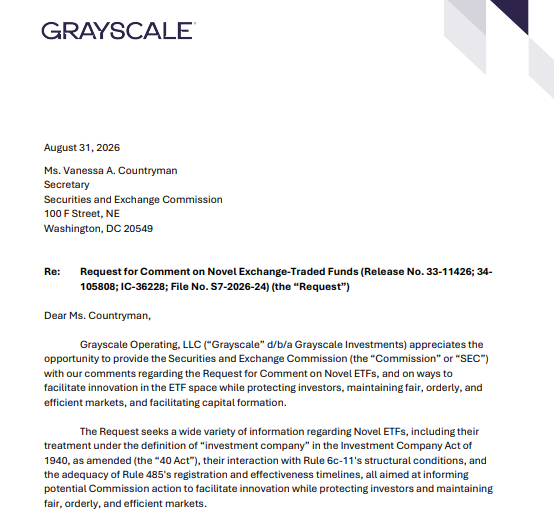
Digital asset manager Grayscale and the Crypto Council for Innovation both backed the idea of an optional confidential pre-filing process, which would let issuers get early feedback before a public review begins.
Shared Opposition to Sweeping Classification Changes
All three groups pushed back against any changes to existing investment-company classification rules that could automatically pull products holding non-securities into the Investment Company Act framework, a shift they argue could create unnecessary regulatory burden.
Comment Period Closes After Two Months
The letters, dated August 31, were submitted as the SEC’s 60-day public comment period wrapped up. The regulator opened the consultation back on June 30 to gather industry input on whether current rules adequately cover next-generation ETFs and whether the registration process needs updating.
Where the Groups Disagree
While the three commenters largely agreed on avoiding blanket restrictions, their views diverged on specific details. a16z argued that crypto-based exchange-traded products already operate under solid market infrastructure, including exchange-approved listing standards, and shouldn’t be lumped in with funds holding private assets or unconventional strategies.
The Fight Over the “ETF” Label
One notable disagreement centered on terminology. a16z proposed reserving the term “ETF” strictly for funds registered under the Investment Company Act of 1940. Grayscale took the opposite stance, arguing the label should reflect a product’s economic function regardless of its legal structure. CCI, meanwhile, called for clearer registration-status disclosures rather than an overhaul of the existing approval framework.
Live market reaction
Disclaimer
This content is for informational purposes only and does not constitute financial, investment, or legal advice. Cryptocurrency trading involves risk and may result in financial loss.
Start trading
with BloFin today
Up to $500 sign-up bonus and zero-fee trading on your first 30 days.
Buy crypto nowⓘ You will be redirected to BloFin
About the author
Covers Bitcoin, on-chain data and market structure. Breaks down what the charts and wallet flows are actually saying, without the hype.

 Guylian ·

.jpeg&w=32&q=75) Laurisa ·
Laurisa ·